



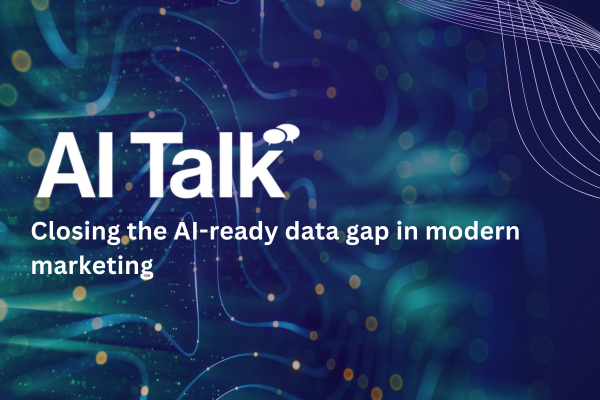
AI Talk: From automation to autonomy - how process and document AI enable agentic transformation
On 30 October 2025, AI Talk host Kevin Craine was joined by Huw Jones, Head of Product - Intelligent Automation, Lloyds Banking Group; Amy Machado, Research Manager, IDC; and Dr. Marlene Wolfgruber, AI Document Strategy Lead, ABBYY.
Please register or log-in to watch this on-demand episode
Agentic Ai and its role in document and process automation
Although gen AI is referred to as a game changer, the rules of the game haven’t changed as far as security and compliance are concerned – guardrails, accurate data, understanding processes and explainability have always been key requirements. According to IDC research, nearly every company has an AI strategy but while 25 % are redefining their products and services to drive operational competitive advantage, 40 % still has concerns about data security and intellectual property, 35% about exposure to third parties and 35% per cent about model accuracy or potential toxicity.
Therefore, enterprises need AI models that they can trust. When mapping your AI journey from automation to agentic AI, you must consider AI deployments’ impact on revenue generation, CX, productivity and efficiency, employee experience, innovation, sustainability, time-to-market, security and trust and – finally – business resilience. Agentic AI makes its decisions based on enterprise content – documents and standard operating procedures. Humans are still part of the process in a system known as human-on-the-loop (HOTL).
The first step to any kind of automation is structuring your unstructured data – that’s what elevates Intelligent Document Processing (IDP) – ingesting, extracting, validating, transforming data – into a key component of automation.
Agentic AI presents new opportunities compared to earlier forms of automation. It’s more proactive, can reason, as well as take the next step. Document AI integrates a number of advanced technologies, such as traditional OCR, advanced AI models. AI including agentic can be leveraged to get insights regarding how workflows and processes can be improved. Agents need not only correct data but also context to operate, which LLMs are there to provide.
What agentic AI brings to the table
Agentic AI is designed for complex and constantly changing workflows – not for rigid and predictable ones. Process AI gives agentic AI situational and process awareness and helps it identify patterns and exceptions, while document AI enables the agent to interpret the meaning from all the business content that drive business decisions. Agentic solutions harness LLMs’ capability to incorporate language and text into an automated process, so document processing is a natural use case, which highly regulated financial institutions embrace for structuring data, summarising it and making it accessible.
Small, optimised models are a better fit for these use cases than LLMs. Customer service is another area where agentic AI can be deployed by banks. We’re still in the experimental stage of agentic AI, where adoption is slowed down by concerns and ambiguities about privacy, security and compliance. Connecting agentic AI to legacy tech stacks can also get fairly challenging or impossible. Out of the box and agentic AI systems built in-house are available for most functions – financial, HR, customer support etc. The metrics for measuring success include efficiency, faster time to resolution, better resource utilisation and cost reduction. Businesses implementing agentic AI also expect these models to improve over time.
What will move the needle forward in terms of adoption is giving these tools to employees in different functions who know their workflows and can experiment with agentic AI to find ways of improving their processes. Earlier technologies such as RPA and APIs combined with a language component can provide a great use case for implementing agentic workflows. You must also ask whether the job to be automated contains human reasoning to decide whether it’s suited for the implementation of gen AI. Here, you must start small and then scale to see where edge cases are, where you need humans to resolve them.
A word of advice though: updates to agents may drastically change the output you get for the same prompts you used before the update. To tackle this, you need the right telemetry and alert system in place, as well as the HOTL. Generative AI can improve security and enable personalisation is customer service contexts. Agents can be omnichannel too, which means that the AI agent you talk to in the contact centre will be the same that you communicate with in the application, and it’ll remember the last point of contact it had with you. Having a mesh of workflows rather than just lines, agentic AI will be radically different from RPA. Agents are often organised into hierarchical teams controlled by a team of teams. Data scientist refer to the dictionary of terms that the model uses and the relationships between them as ontology.
The panel’s advice
- Lloyds has set itself the target of generating £50M of value across 50 use cases with gen AI. They have used agentic AI for reviewing hundreds of thousands of credit agreements for regulatory purposes, saving £25M in payroll.
- Talk to IT to identify which processes are suited to agentic workflows.
- Orchestration and BOAT (Business Orchestration and Automation Technologies) are key to operating an agentic framework.
- The biggest performance gains from gen AI come from use cases that combine it with other intelligent technologies, such as document and process AI.
- Responsible AI must be layered into agentic AI deployments.

Business Reporter Team



Most Viewed


Winston House, 3rd Floor, Units 306-309, 2-4 Dollis Park, London, N3 1HF
23-29 Hendon Lane, London, N3 1RT

020 8349 4363

© 2025, Lyonsdown Limited. Business Reporter® is a registered trademark of Lyonsdown Ltd. VAT registration number: 830519543