



The "Goods Not For Resale" opportunity
Ian Hall at CCS McLays explains how retailers can turn a hidden cost in UK fashion retail into a lasting competitive advantage

As retailers are doubling down on costs to navigate another uncertain year, there is continuing pressure on the UK fashion retail sector. With clothing and footwear sales forecast to grow by just 2.3% in 2026 (according to the Retail Economics and CCS McLays 2026 Report From blind spot to retail advantage), there looks to be a hidden value that retail leaders have overlooked.
A new research report launched by leading retail consumables specialist CCS McLays, in partnership with Retail Economics, has uncovered a £276m hidden cost opportunity in UK fashion retail, driven by widespread mismanagement of Goods Not for Resale (GNFR).
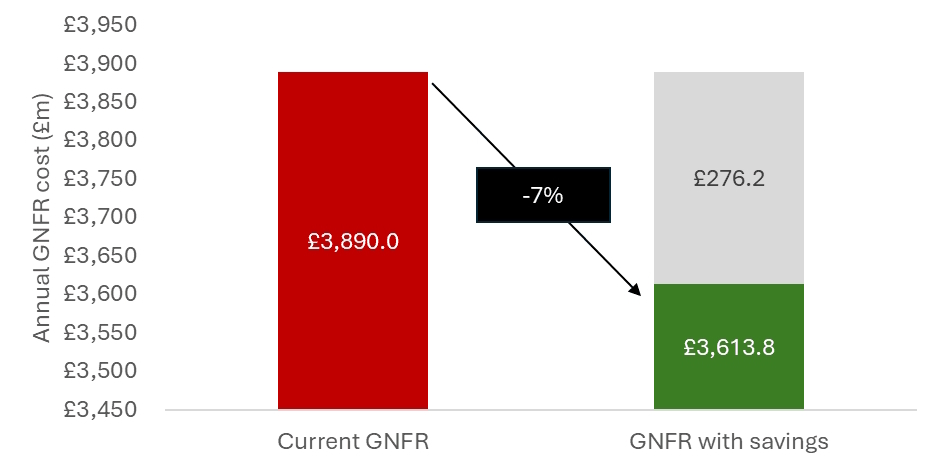
The report, From blind spot to retail advantage: How GNFR is reshaping profitability in UK fashion retail reveals that UK fashion retailers could achieve an average 7% reduction in GNFR costs through a more systematic and strategic approach. This long-overlooked blind spot translates into £276m in sector-wide savings (Fig 1 below), flowing directly to operating profit and equivalent to the profit generated by £5.9bn in additional sales - without the need for new stores, additional staff, or expanded channels.
GNFR includes the products and services retailers rely on to keep operations running but do not sell to customers, such as packaging, store consumables, point-of-sale (POS) materials, and office and IT supplies. While GNFR underpins daily operations across stores, warehouses, and ecommerce, it often receives limited senior attention despite its scale and growing complexity.
Retailers have limited ability to offset rising costs through price increases or volume growth. As a result, a third of apparel retailers are prioritising profitability in 2026, with GNFR representing one of the few remaining levers available to protect margins without undermining customer value.
Despite this, the study found that the single biggest barrier to improving GNFR cost control is leadership buy-in, cited by 24% of retailers, followed by resource constraints (22%) and supplier market structure (21%). Trading updates tend to focus on merchandise costs, yet a significant share of margin pressure sits within non-merchandise spend.
GNFR spending across UK fashion retail was estimated to reach £3.9bn in 2025, up 2.2% year on year, driven by three structural trends: embedded packaging inflation following years of supply disruption; rising wage costs being absorbed into GNFR contracts; and persistently high returns rates increasing demand for consumables, transit packaging, and processing materials. Retailers estimate that improved GNFR visibility and governance could lift sector operating profits by more than 8%, without additional stores, staff, or customer price increases.
The report also highlights material differences by channel and scale. Online-led retailers face GNFR ratios two to three percentage points higher than store-based peers, reflecting the variable cost structure of ecommerce, where packaging, fulfilment, and returns scale directly with order volumes (Fig 2 below).
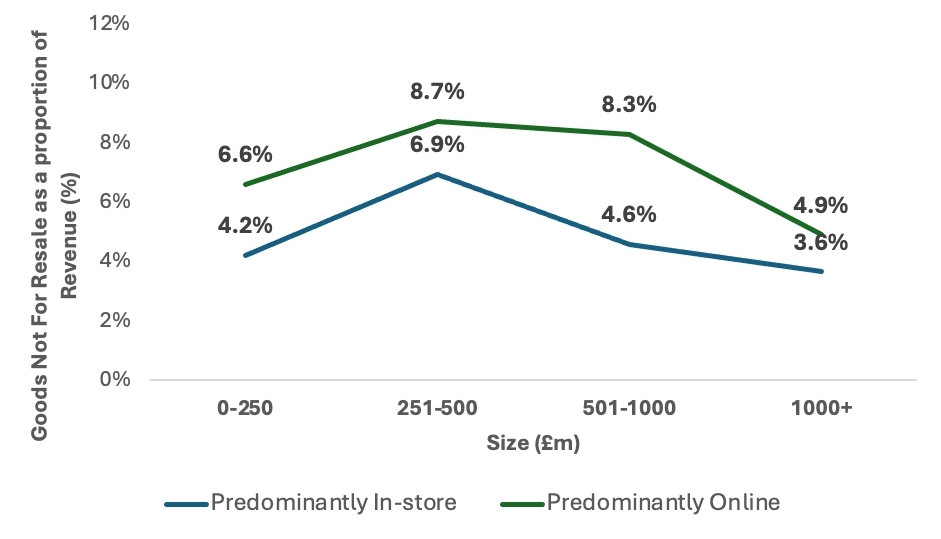
The research reveals size as a key determinant of GNFR efficiency with 90% of mid-sized businesses (£250-500m turnover) considering GNFR a blind spot. Of all size groups, the medium sized businesses surveyed said they most need data and analytics (29%) and stronger leadership sponsorship, accountability and ownership in GNFR within business (27%) to manage their GNFR effectively. As retailers grow into this medium-size bracket, they struggle to manage priorities. Although many know where the inefficiencies lie, adoption is weak with accountability dispersed.
Meaningful progress only happens when GNFR has clear senior ownership. Executive teams set the ambition, define compliance expectations and bring procurement into core planning rather than leaving it on the sidelines. Smaller retailers tend to be reactive and under-resourced, and only the largest players demonstrate strong strategic control - where even small efficiency gains translate into multi-million-pound profit improvements.
Crucially, GNFR optimisation is about more than just cost reduction. Over a third (35%) of retail leaders surveyed would reinvest GNFR savings into innovation and transformation, positioning GNFR management as a strategic enabler of long-term growth and resilience.
To support this shift, CCS McLays has developed The Hidden Value Index, a structured framework that assesses GNFR maturity across transparency, efficiency, innovation, and resilience. The Index benchmarks retailers to identify where cost leakage occurs and where targeted intervention will deliver the greatest impact.
GNFR maturity is now a commercial differentiator. There’s a clear performance gap between retailers with structured procurement practices and those relying on fragmented, reactive processes. Higher maturity correlates with lower GNFR ratios and stronger resilience.
When revenue growth is muted, absorbing operating cost inflation becomes much tougher. With limited scope to pass on higher costs to customers, any rise in non-merchandise spend puts further pressure on already thin margins. Even modest improvements in GNFR discipline can unlock real savings, build resilience, and free up investment for transformation. Within just a matter of weeks, retailers can identify ways to optimise consumables that have a marked impact on business performance.
According to Richard Lim at Retail Economics, “When sales growth is flat, the battleground for profitability shifts to the cost base. Procurement has quietly become one of the least visible drags on margin in fashion retail. The challenge is particularly acute in the mid-market, where retailers are being squeezed by rising costs, operational complexity and the need to keep investing in innovation to stay competitive. A £276m opportunity sitting outside core trading is a strategic opportunity to innovate as spending remains under pressure.”
Retailers who take a systematic approach to GNFR - improving visibility, consolidating suppliers, and strengthening governance - can turn a hidden cost into a lasting competitive advantage. Those that delay risk leaving significant margin unrealised in an already pressured market.
Ian Hall is CEO at CCS McLays
Main image courtesy of iStockPhoto.com and Hanizam

Business Reporter Team






Most Viewed


Winston House, 3rd Floor, Units 306-309, 2-4 Dollis Park, London, N3 1HF
23-29 Hendon Lane, London, N3 1RT

020 8349 4363

© 2025, Lyonsdown Limited. Business Reporter® is a registered trademark of Lyonsdown Ltd. VAT registration number: 830519543