



A double-click on the double bottom line
Sponsored by SnowflakeHow the data from sustainability initiatives is good for business agendas – in more ways than one



AI can help accelerate business decision making and drive forward sustainability in meaningful ways – and in ways that might not even be recognised as doing “good”. Optimising production levels, minimising waste and promoting efficient energy consumption all deliver value to a company’s bottom line – and to the planet as well. Intentionally or not, companies pursue a double bottom line of profitability and sustainability. Sustainability can be sustainable.
Doing good with data: a brief history
Basic definitions of sustainability include “the ability to be maintained at a certain rate or level”, or “the ability to use resources without depletion or damage”. However, today, the term packs a lot more punch. The United Nations has defined sustainability as “meeting the needs of the present without compromising the ability of future generations to meet their own needs.” Understanding how to address current needs while predicting future impact requires robust analysis, and vast amounts of data, often referred to as “data for good”.
The use of “data for good” has a rich history, tracing its roots to 17th century studies on London’s birth and death rates that pioneered public health statistics and informed public policy. But the modern term evolved with the growth of data science, open data initiatives, and social responsibility, notably spurred by Tim Berners-Lee’s call for “raw data, now” to fuel social policy. The term’s use grew exponentially, as illustrated by the growth of references in publications (see graph below).
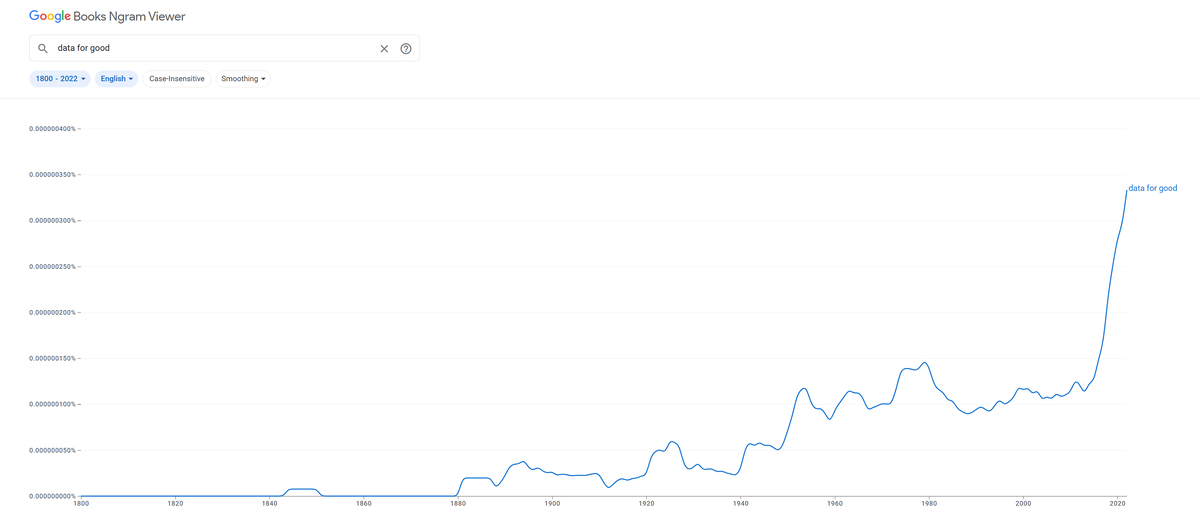
This movement was given its current, global mandate to use data to achieve positive social outcomes when the UN outlined ambitious goals for improving health, reducing inequality and tackling climate change.
Doing good makes for better business
While “data for good” has traditionally been associated with the mission of governments and non-profits, it belongs squarely in the private sector as well. Companies have demonstrated that doing “good”, particularly for the planet, means better business. And, despite coming under political fire and reports of a climate backlash, sustainability goals remain top of mind across the C-suite.
According to a recent Bain & Company report, The Visionary CEO’s Guide to Sustainability 2025, 54 per cent of CEO statements linked sustainability to business value, up from 34 per cent in 2018. A Forbes study in August 2025 found that 79 per cent of companies globally had a Chief Sustainability Officer or equivalent. And, even more significantly, 93 per cent of them expected larger budgets in the next 12 months compared with the previous 12 months.
Chief Financial Officers concur. And, a recent Kearny study confirms 92 per cent of CFOs say they will invest more in sustainability, with more than half saying they will significantly increase their investments. By how much? Nearly two-thirds plan to allocate more than 2 per cent of their revenue to sustainability initiatives in 2025.
At the 10-year anniversary of the UN SDGs, sustainability just makes sense, not only as a means to reduce costs and risks, but as a strategy to gain mind and market share. Customers require it. The Chief Sustainability Officer of a large US-based software company described how they track customers’ sustainability requirements, representing millions of dollars in customer contracts, to justify investment.
Sustainable practices influence purchasing decisions
Customers care about the economic, social and environmental impact of products and services. Studies have found that:
Consumers will pay more for sustainable products. According to studies conducted by the US National Retail Federation, between half to two-thirds of consumers said they will pay more for sustainable products. In particular, concerns about climate change drive choices: a NielsenIQ survey found that 73 per cent of consumers would change their habits to reduce their environmental impact.
Value-based buying will accelerate. According to the Deloitte 2025 Gen Z and Millennial Survey, 65 per cent of Gen Z and 63 per cent of millennials are willing to pay more for environmentally sustainable products or services. With a projected disposable income of $360 billion, according to Bloomberg, that represents big business.
Customers actually do (literally) vote with their feet. They don’t just vote with their wallets. Several recent studies confirm that negative ESG news significantly impacts consumer store visits, ultimately reducing firms’ financial performance.
And, these findings don’t just apply to consumers, business buyers impose sustainability criteria as well.
Sustainability is a top priority for companies. In an Economist impact study into procurement in 2025, over half (53 per cent) of survey respondents named sustainability as their top strategic priority for the next 12 to 18 months.
One third of B2B buyers are willing to switch and pay a premium. The Bain & Company 2024 survey, cited above, found that more than a third of companies are willing to leave suppliers that don’t meet their sustainability criteria, with nearly 60 per cent expecting to do so within three years. The same survey reported that 80 per cent of B2B buyers paid a premium for their most recent sustainable product.
B2B buyers use ESG metrics to select vendors. Research by Enterprise Strategy Group found that 85 per cent of organisations have eliminated a potential technology supplier due to ESG concerns. With Scope 2 and 3 accountability, a vendor’s ESG performance directly impacts the buyer’s own ESG reporting and risk profile.
Moving the bottom line: “good” means better business
Sustainable practices are rapidly becoming “best practices”. Investments in site locations, choice and geographical sourcing of inputs, supplier selection, logistics and most other business decisions are based on data insights. Often the results positively impact both profits and the planet.
These aren’t just corporate social responsibility (CSR) initiatives. In fact, for many companies, CSR initiatives are good business decisions and vice versa.
At Workday, commitments to sustainability represent business as usual. Its 2025 Global Impact Report underscores how the company’s “environmental, social and governance initiatives are not separate undertakings, but rather integral components of a holistic business strategy,” according to its Chief Sustainability Officer. Workday not only provides tools to source and track supplier sustainability data; it is itself committed to lowering its own carbon footprint, a significant competitive differentiator – and a direct response to customer demand.
At Cargill Ocean Transport, sustainability initiatives are also strongly linked to business value, primarily through cost savings, enhanced operational efficiency, risk mitigation and market positioning. Its 2024 Decarbonization Update reported 1.35 million metric tons of estimated CO2 emissions avoided in 2024 as a result of a 3 per cent improvement in its Energy Efficiency Operational Indicator, compared with a 2017 baseline. That efficiency was data-driven – by voyage and weather optimisation combined with an understanding of market conditions affecting speed, routes and other factors.
These examples illustrate the pursuit of the double bottom line of protecting or promoting both profits and the planet – and the role of data for “good” and better business.
by Jennifer Belissent, Principal Data Strategist, Snowflake

Business Reporter Team




Most Viewed


Winston House, 3rd Floor, Units 306-309, 2-4 Dollis Park, London, N3 1HF
23-29 Hendon Lane, London, N3 1RT

020 8349 4363

© 2025, Lyonsdown Limited. Business Reporter® is a registered trademark of Lyonsdown Ltd. VAT registration number: 830519543